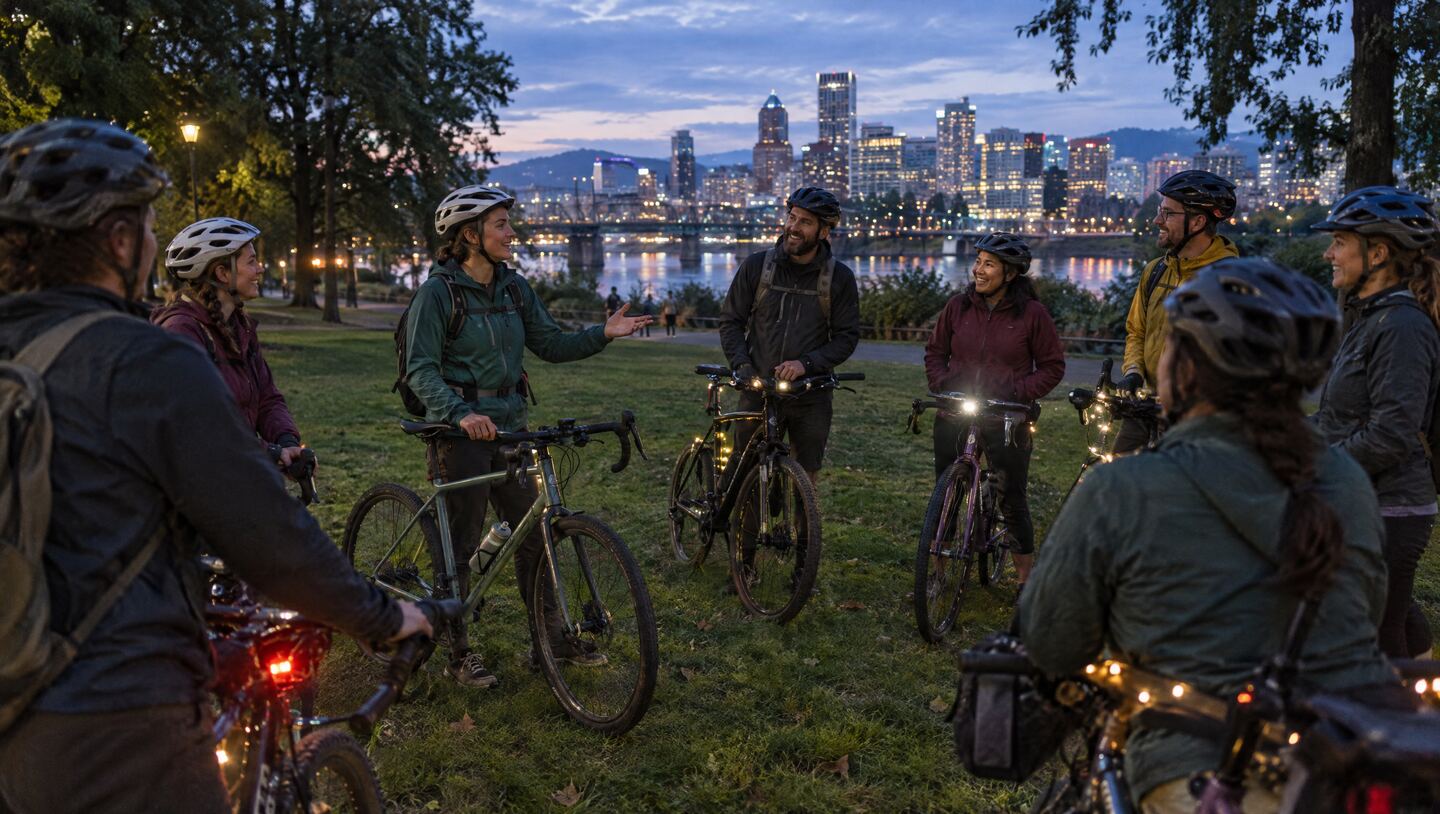
How to lead your first group ride
Ever been on a group ride and thought, “Hey, I could do this”?
Well, you probably can!
One of the best things about Portland’s cycling community is that anyone can organize a ride. You don’t need to belong to a club, be an experienced cyclist, or even be particularly good at giving directions.
All you really need is an idea, a place to meet, a route, and a willingness to bring some people along for the adventure.
Of course, if you’ve never led a ride before, you might have a few questions. What if nobody shows up? What if you get lost? What if people can’t keep up? What exactly are you supposed to do when you’re the person everyone is following?
Those are all perfectly reasonable things to wonder about.
The good news is that leading a group ride doesn’t have to be complicated. A little planning, some common sense, and a friendly attitude go a long way.
Here’s how to make it happen.
On this page 16 sections
- Wait, anyone can lead a ride?
- Start with an idea
- Plan a route people will enjoy
- Pick a good meeting spot and time
- Put your ride on the calendar
- How do I get people to show up?
- Should I bring some helpers?
- It’s ride day! Now what?
- What do I say before we start?
- How do I know if I’m going too fast?
- What about traffic laws?
- What’s the deal with corking?
- What if something goes wrong?
- Help everyone feel welcome
- How do I wrap things up?
- Ready to give it a try?
Wait, anyone can lead a ride?
Yep. Anyone.
Portland has a long tradition of community-organized bike rides, and the whole idea is that people like you can make them happen.
Most of these rides are listed on Shift’s calendar, where anyone can post an event for free.
There’s no certification to earn, no organization you have to join, and no minimum number of rides you need to attend before leading one yourself.
You come up with an idea, put it on the calendar, and invite people to join you.
That’s really how a lot of Portland’s favorite rides got started.
Just remember that when you organize a ride, you’re also taking responsibility for helping it run smoothly. You don’t have to have all the answers, but people will be looking to you for direction.
And that’s something you can absolutely learn as you go.
Start with an idea
The best rides often start with a simple thought: “Wouldn’t it be fun if we rode bikes to...”
Maybe there’s a bakery you love, a neighborhood full of interesting murals, or a particularly great place to watch the sunset.
Maybe you want to put on some music and lead a slow cruise through the city. Or organize a ride where everyone dresses like their favorite movie character.
Maybe you just want to spend a Sunday afternoon riding around with some nice people.
All of those are perfectly good reasons to organize a ride.
You don’t need an elaborate theme, a hundred participants, or a big production. Some of the most enjoyable rides are small, simple, and wonderfully ordinary.
Who’s your ride for?
Once you’ve got an idea, give a little thought to the people you’d like to join you.
Are you imagining a relaxed ride for beginners? Something families with kids could enjoy? A longer adventure for people who love putting in miles?
There’s no wrong answer, but knowing your audience will help you make decisions about the route, distance, pace, and stops.
A family-friendly afternoon ride is going to look pretty different from a late-night ride that visits a few bars.
And that’s fine. Portland has room for both.
If you’re feeling unsure about where to start, talk to someone who’s organized a ride you enjoyed. Most ride leaders are happy to share what they’ve learned, and you might even find someone willing to help with your first one.
Plan a route people will enjoy
You’ve got an idea. Now comes the fun part: figuring out where everyone will go.
One of the most important things to remember is that riding a route by yourself is different from leading a group through it.
An intersection you barely notice on your commute might be surprisingly difficult for twenty people to cross together. A hill that feels easy to you might be exhausting for someone who’s just getting comfortable on a bike.
Try to think about the experience from the perspective of the least experienced rider you’re expecting.
A few things are worth considering.
Distance and pace
How far do you want to go, and how long should the ride last?
Don’t forget to account for stops. A six-mile ride with a few breaks might turn into a leisurely two-hour outing, and that’s not necessarily a bad thing.
If you’re organizing a family-friendly ride, keeping the route to around six miles or less is a good starting point.
For a casual social ride, you’ll often hear people use the term party pace.
There’s no official definition, but in Portland it often means something around 10 to 12 mph, while slower or beginner-oriented rides might travel closer to 6 to 9 mph.
Actual speeds will vary, especially on hills. On a relaxed ride, you might find yourself traveling around 5 mph uphill, 7 mph on flat streets, and 10 to 12 mph downhill.
The exact numbers aren’t terribly important. What matters is that you choose a pace that fits the people you’re inviting and describe it accurately in your listing.
And remember, when you’re leading, it’s surprisingly easy to go faster than you realize.
We’ll come back to that.
Choose comfortable streets
Portland has a fantastic network of neighborhood greenways, quieter residential streets, bike paths, and other places that can make for enjoyable group riding.
Use them!
Whenever possible, avoid busy streets where traffic moves quickly or the group is likely to get separated at intersections.
Pay attention to railroad tracks, tricky turns, narrow roads, and places where riders might have trouble staying together.
You don’t need to eliminate every challenging section, but you should know about them ahead of time so you can prepare your riders.
Plan some stops
Stops aren’t just for catching your breath. They’re a big part of what makes group riding social.
A park, a scenic viewpoint, a coffee shop, or a place to grab a snack can give everyone an opportunity to relax and chat.
Stops also give slower riders time to catch up and provide a chance to deal with mechanical issues.
Bathrooms and drinking water are especially appreciated. If you’re planning a longer ride, try to include at least one place where people can refill their bottles or use a restroom.
And if people are going to eat, encourage them to do it while stopped rather than trying to juggle snacks and handlebars in the middle of a group.
Think about the finish
Where will your ride end?
For your first ride, a loop that finishes where it started is often the easiest choice.
Everyone already knows how to get back to the meeting spot, and there’s less confusion about getting home.
But there’s nothing wrong with a one-way ride, either.
Just make sure people know where it ends and have a reasonable way to get home. Ending near a transit stop can be particularly helpful.
Now go ride it yourself
Seriously. This is one of the best things you can do before leading a group.
Even if you know the area well, test ride the entire route before your event.
Look for anything that might cause problems for a group: construction, awkward intersections, steep hills, railroad tracks, or places where people could easily miss a turn.
Think about what traffic might be like at the time of your ride, not just when you’re scouting.
And consider the weather and available daylight. If something changes, having a backup route or rain date in mind can save you a lot of last-minute stress.
Pick a good meeting spot and time
A good meeting spot doesn’t need to be fancy. It just needs to be easy to find and comfortable for people to gather.
Parks, plazas, and other public gathering spaces are popular choices.
Bonus points if there’s a bathroom, drinking water, or somewhere nearby to grab a coffee.
If you’re organizing a ride outside central Portland, consider starting near a TriMet transit center or another place that’s easy to reach without a car.
And be specific about where people should meet.
“Meet at Laurelhurst Park” might sound straightforward, but it’s a big park.
“Meet by the picnic shelter near the north entrance” gives people a much better chance of finding you.
When should you schedule it?
Before choosing a date and time, take a look at the Shift calendar.
See what else is happening that day. You might want to avoid competing with another big ride, especially if you’re hoping to attract some of the same people.
Think about the time of day, too.
If your ride might continue after sunset, make sure people know they’ll need lights. Oregon requires a white front light visible from at least 500 feet and a red rear light or reflector visible from at least 600 feet when riding after dark or in other low-visibility conditions.
It’s much better to mention that ahead of time than discover someone doesn’t have lights when you’re already halfway through the ride.
Put your ride on the calendar
You’ve got an idea, a route, and a meeting spot.
Time to invite some people!
Portland’s community bike calendar is run by Shift, and anyone can submit a ride for free.
The basics are simple. You’ll need a title, an organizer name, a date and time, and a starting location.
You can use your own name, a nickname, or the name of a group you’re organizing with.
But here’s our advice: give people more information than the minimum.
Your listing is what helps someone decide whether your ride sounds like something they’d enjoy.
The clearer you are, the more likely you’ll attract people who are a good fit.
What should you include?
Here are the details that make a listing genuinely useful:
- A clear meeting time and departure time. “Meet at 6:00 PM, roll at 6:30 PM” is much more helpful than just “6:00.” Double-check AM and PM, too!
- An exact meeting location. Include landmarks or directions if the spot might be hard to find.
- The expected pace. Casual, party pace, slow, fast, or beginner-friendly. Whatever best describes what you’re planning.
- Whether it’s no-drop. A no-drop ride makes an effort to keep everyone together, including slower riders and people dealing with mechanical problems. Only describe your ride this way if you intend to follow through.
- Distance and duration. Give people a sense of how far you’re going and how long they should expect to be out.
- Where the ride ends. Let people know whether it’s a loop or a one-way trip.
- Road conditions. If the route includes hills, busy roads, or other challenging sections, give people a heads-up.
- Who the ride is for. Shift lets you mark rides as general, family-friendly, or adults-only (21+).
- Themes or costumes. If you’re hoping people will dress up, tell them! Specific suggestions are easier to follow than vague ones.
- Any costs. Most community rides are free. If yours involves a fee, make that clear.
- A way to ask questions. Consider providing a public contact method so people can reach you beforehand.
If your ride includes a bar stop, Shift requires you to mark it adults-only. And if there’s anything else participants should know about, including nudity or potentially sensitive content, mention it in the description.
For family-friendly rides, it’s also helpful to explain what skills younger riders should have, such as being able to start, stop, ride in a reasonably straight line, and follow directions.
Remember that Oregon requires riders under 16 to wear helmets.
What’s “bikey time”?
You’ll hear this phrase around Portland.
Bikey time is the tradition of giving people a little extra time to arrive before a ride leaves.
Shift encourages leaders to wait at least 15 minutes after the listed meeting time. Plenty of rides allow 30 minutes.
It’s a nice opportunity for people to socialize and for newcomers to get comfortable.
Just make sure your listing clearly explains when people should arrive and when you’ll actually start riding.
And once that departure time arrives, try to stick to it. The people who showed up on time will appreciate it.
How does Biiikes fit in?
Right now, rides are submitted through Shift, not directly through Biiikes.
Once you’ve published your ride on Shift, it should appear on Biiikes shortly afterward, complete with a link back to the original listing.
If you need to update or cancel your ride, make those changes on Shift. Biiikes will pick them up.
One important detail: Shift emails you a special link to manage your listing. Treat that link like a password. Anyone who has it can edit your ride, so keep it somewhere safe.
If you need to cancel, use that link to change your ride’s status from Scheduled to Cancelled. You can also post a short update, which Shift calls a “newsflash,” to explain what’s happening.
How do I get people to show up?
Tell them about it!
Seriously, that’s the main thing.
Share your ride with friends. Post it on social media. Mention it to people you meet on other rides.
If you enjoy making flyers, make some flyers. If you’re part of a group chat with other cyclists, share the listing there.
And don’t underestimate how effective a personal invitation can be.
Sometimes all it takes is one person saying, “Hey, I’m going to this ride. Want to come?”
What if nobody comes?
Well, that can happen.
Even experienced organizers occasionally put together a ride that doesn’t attract much interest.
Maybe the weather isn’t great. Maybe there’s another big event happening. Maybe people are just busy.
Try not to take it personally.
You came up with an idea, planned a route, put it out into the world, and showed up.
That’s something to be proud of.
And hey, you still get to go for a bike ride.
If you want to try again, ask another ride leader for suggestions. Sometimes changing the day, time, or description can make all the difference.
Should I bring some helpers?
You can absolutely organize a small, simple ride on your own.
But if you’re expecting more than a handful of people, having a friend or two help out can make the experience much easier.
You don’t need a big volunteer crew. A couple of people who know the plan can make a real difference.
Meet your new best friend: the sweep
A sweep is someone who rides at the back of the group.
Their main job is to help make sure nobody gets accidentally left behind.
Ideally, your sweep knows the route, can communicate with you, and is comfortable helping riders who need a little extra attention.
Having a phone number for each other is a great start.
It’s also helpful if your sweep carries a basic repair kit or knows how to handle a flat tire.
Other helpful people
Depending on the size and style of your ride, you might also appreciate:
- A second helper who can stay with someone having trouble while the group continues to a safe stopping point.
- Someone who knows basic bike repairs and can help with common mechanical problems.
- A co-leader who knows the route and can help manage the group.
- A sound crew if music is part of the experience.
You don’t need all of these people for every ride.
The point is simply that you don’t have to do everything yourself.
And if this is your first time leading, having an experienced friend along can take a lot of pressure off.
It’s ride day! Now what?
First things first: check the weather.
And while you’re at it, check the air quality.
A little rain might not be a big deal, but extreme heat, snow, ice, or unhealthy air quality can be good reasons to change or cancel a ride.
If you do cancel, update the listing on Shift so people know what’s happening.
Assuming everything looks good, gather your supplies.
A pump, tire levers, patch kit, basic first aid kit, your phone, and contact information for your helpers are all worth having.
Try to arrive at the meeting spot about 15 to 30 minutes early.
That gives you time to get organized, greet people as they show up, and answer questions.
You might also help someone with a quick bike check if they need it. Tires inflated? Brakes working? Chain in good shape?
Most importantly, remember that you’re allowed to enjoy yourself.
You organized this ride because riding bikes with people sounded like fun.
Don’t forget that part!
What do I say before we start?
Before everyone rolls out, gather the group for a quick introduction.
Don’t worry. You don’t need to give an inspiring speech or sound like a professional tour guide.
A minute or two is usually plenty.
Introduce yourself, thank everyone for coming, and explain the plan.
Here’s what people will want to know:
- Where you’re going and roughly how long the ride will take.
- Where you’ll stop, including any planned bathroom breaks.
- Whether the route loops back or finishes somewhere else.
- Any tricky intersections, hills, or other challenges ahead.
- How fast you expect to go and whether you’ll wait for slower riders.
- Who’s helping, especially the sweep.
- How you’ll handle intersections and regrouping if people get separated.
This is also a good time to explain any calls or signals you’ll use.
A few useful calls
Group riders often communicate by calling out what’s happening around them.
You might hear:
- “Car back!” A car is approaching from behind.
- “Car up!” A car is coming toward the group.
- “On your left!” Someone is passing on the left.
Pointing out hazards like glass, gravel, potholes, and railroad tracks can also help the riders behind you.
One especially important thing to remind everyone: each person is responsible for making sure it’s safe before crossing an intersection.
Nobody should blindly follow someone else into traffic just because they heard the word “clear.”
Don’t forget the newcomers
Before leaving, ask if anyone is on their first group ride.
You might be surprised how many hands go up.
Give them a warm welcome and let them know they’re welcome to ask questions or speak up if they need a break.
A little reassurance can make someone’s first group ride a much better experience.
And with that, you’re ready to roll.
How do I know if I’m going too fast?
Here’s a little secret about leading a group ride:
You’re probably going faster than you think.
When you’re at the front, you’re naturally focused on the route, the next turn, and everything happening around you.
Add a little excitement or nervous energy, and it’s easy to start moving faster without realizing it.
So make a habit of checking behind you.
Are people keeping up comfortably? Can they still chat with each other? Is the group staying reasonably together?
If everyone looks relaxed and happy, you’re probably doing just fine.
If the group is stretching out into a long line, ease up.
Wait for your people
Intersections and hills have a way of spreading a group out.
That’s normal.
If your ride is meant to stay together, find a safe place to pull over and wait for everyone to catch up.
Try not to stop somewhere that blocks a bike lane, sidewalk, or intersection.
And if a traffic light splits the group, don’t panic.
The people in front can find a safe place to wait on the other side while everyone else follows when it’s their turn to cross.
Nobody needs to run a red light to catch up.
A little patience goes a long way toward making group rides enjoyable for everyone.
What about traffic laws?
Here’s something important to remember:
Being part of a group doesn’t change the rules of the road.
Even if you’re riding with fifty other people, everyone is still responsible for following traffic laws and riding safely.
A few Oregon rules are especially worth knowing.
Traffic lights and stop signs
Red lights mean stop.
If the light changes while part of your group is still approaching the intersection, those riders need to stop and wait for the next green.
Oregon also allows people on bikes to treat stop signs as yield signs in many situations.
That means you may proceed without coming to a complete stop when it’s safe and legal to do so, but you still need to slow down, yield when required, and watch for people walking or other traffic.
And importantly, every rider makes that decision individually. Just because the person ahead of you crossed doesn’t mean it’s safe for you to follow.
Signaling turns and stops
Use hand signals when turning or stopping, when it’s safe to do so.
Oregon generally requires signaling for at least 100 feet before a turn or stop, with an exception when you need both hands to control your bicycle.
Calling out an upcoming turn can be helpful too, especially when you’re leading a large group and people farther back can’t see you.
Riding side by side
Oregon generally allows two people to ride side by side, as long as they stay within a single lane and don’t impede the normal movement of traffic.
Three or more across isn’t permitted under that general rule.
Encourage people to spread out or ride single file when conditions call for it.
The goal isn’t to make group riding feel rigid or stressful. It’s to help everyone travel together without creating unnecessary risks for the group or the people sharing the road.
What’s the deal with corking?
If you’ve been on a larger Portland ride, you’ve probably seen people stop at intersections while the rest of the group passes.
They’re called corkers, and they can be a familiar part of large community rides.
The idea is to hold cross traffic so the group can stay together as it moves through an intersection. In practice, on some rides, that can mean the group keeps rolling through after the light has turned red.
But there’s an important catch: corking doesn’t give anyone legal authority to direct traffic.
Oregon law doesn’t define corking or treat it as a special traffic privilege. A volunteer can’t legally require drivers to stop or give a group permission to proceed through a red light. Only police can.
And while it might look simple from the middle of a ride, corking carries real risks.
For your first ride, you probably don’t need to worry about it at all.
Choose a comfortable route, follow traffic signals, and regroup when the group gets separated.
If you eventually organize larger rides and decide to work with experienced corkers, keep a few things in mind:
- Never treat corking as permission to ignore a traffic signal. The light still applies to every rider. If the group keeps rolling through after it turns red, that’s on you, and the law won’t back you up.
- Avoid fast or busy roads. If conditions aren’t appropriate, let the group split and regroup somewhere safe.
- Use experienced volunteers. Don’t ask someone to cork just because they happen to be standing nearby.
- Have volunteers work together. Communication and coordination matter.
- Don’t confront drivers. If someone becomes impatient or aggressive, prioritize getting everyone out of danger.
Above all, don’t put volunteers in a position where they’re expected to physically block vehicles or direct traffic without legal authority.
A few extra minutes spent regrouping is a much better outcome than someone getting hurt.
What if something goes wrong?
At some point, something probably will.
Someone gets a flat. Someone misses a turn. Someone needs a break. Someone realizes their bike has been making a very suspicious noise for the last two miles.
That’s just part of riding bikes.
You don’t have to handle every situation perfectly. You just need to stay calm, communicate, and make reasonable decisions.
Someone gets a flat tire
Find a safe place to pull off the road.
If you’ve got someone who can help with repairs, great!
Depending on the ride, the group might wait, or a helper might stay with the rider while everyone else continues to the next planned stop.
If the bike can’t be fixed, help the rider figure out a safe way home.
Someone is falling behind
Slow down or stop somewhere safe and check in.
Maybe they’re tired. Maybe they’re having a mechanical issue. Maybe the pace just isn’t what they expected.
Ask what they need.
Sometimes a short break solves everything. Other times, helping someone find a shorter route home is the kindest thing you can do.
Nobody should feel embarrassed about needing to take it easy.
Someone gets hurt
Stop somewhere safe and assess the situation.
For a serious injury or medical emergency, call 911.
Don’t try to move someone with a potentially serious injury unless they’re in immediate danger, and don’t feel like you need to handle an emergency by yourself.
An angry driver
Unfortunately, not everyone is delighted to encounter a group of cyclists.
If a driver gets frustrated or confrontational, don’t escalate things.
Stay calm, avoid arguments, and focus on getting your group somewhere safe.
You’re not going to change someone’s mind about bicycles by shouting at them through a car window.
You’ve got better things to do.
Help everyone feel welcome
One of the best things about Portland’s group riding community is the incredible variety of people who participate.
Different ages, different backgrounds, different abilities, different bikes, and different reasons for showing up.
As a ride leader, you have a real opportunity to help people feel like they belong.
And that starts with something as simple as saying hello.
Welcome newcomers. Answer questions without making people feel silly. Pay attention to riders who seem uncertain or uncomfortable.
You don’t need to be everyone’s best friend. Just make it clear that they’re welcome to be there.
A few things worth keeping in mind
Respect personal boundaries. Ask before touching someone or their belongings. Be considerate when taking photos or recording video, especially if you plan to share them publicly.
Don’t tolerate harassment. If someone is being harassed or made to feel unsafe, take it seriously and intervene in a way that prioritizes safety. Shift asks ride leaders to uphold its Code of Conduct and report harassment concerns to [email protected].
Be mindful of the people around you. That includes pedestrians, drivers, people enjoying parks, and residents of neighborhoods you’re riding through.
Keep things safe and appropriate. Shift prohibits weapons at its listed rides, including fireworks. If your event involves a fire or grill, follow applicable rules and burn restrictions.
Shift’s Code of Conduct sums up the spirit of community rides nicely: have fun, be kind to one another, and keep yourself safe.
It’s worth reading before you organize your first ride.
And remember, as the leader, people will naturally take cues from you.
If you’re patient, welcoming, and respectful, that attitude tends to spread through the group.
How do I wrap things up?
You’ve made it!
Everyone has arrived at the final stop, bikes are leaning against things, and people are probably standing around chatting.
Before you disappear into the sunset, make sure everyone knows the ride is officially over.
It sounds obvious, but announcing something like “Alright, that’s the ride! Thanks for coming!” avoids confusion about whether there’s another stop.
If you’re finishing somewhere unfamiliar, help people figure out how to get home. Point out nearby transit or a good route back toward the city.
Thank everyone for joining you.
And be sure to thank your helpers, especially your sweep and anyone who helped with mechanical issues or kept the group organized.
A little recognition goes a long way.
If you’re planning another ride, this is a great time to mention it. People who had a good time will probably want to join you again.
And don’t forget to take a moment to enjoy what you just accomplished.
You came up with an idea, invited a bunch of people, and made something happen.
That’s pretty cool.
Ready to give it a try?
Here’s the thing about leading a group ride: you don’t have to be the fastest, most experienced, or most outgoing person in the group.
You don’t need a huge following or an elaborate event.
You just need to care enough to create a good experience for the people who show up.
Start small if you want. Invite a few friends. Choose a route you know well. Pick a destination that sounds fun.
You’ll learn something every time you lead, and each ride will make the next one a little easier.
And who knows? That little ride you organized because you thought it sounded fun might become someone else’s favorite way to spend a Thursday night.
That’s how communities grow.
Come up with an idea. Pick a route. Put it on Shift. Invite some people.
We’ll see you out there!