Your first group ride
Never been on a group bike ride before? You’re in the right place.
Portland has an incredible group riding community, and there’s a ride out there for just about everyone. Whether you’re looking to meet new people, explore the city, get some exercise, or just have a good time on your bike, group rides are a great way to do it.
If you’ve never joined one, you might have a few questions. How do you find a ride? What should you bring? What if you don’t know anyone? What if you’re too slow?
We’ve got you covered.
This guide will walk you through everything you need to know, from finding your first ride to getting home afterward.
On this page 14 sections
- First things first, what’s a group ride?
- Finding your first ride
- What should I bring?
- Okay, I’m here. Now what?
- What if I don’t know anyone?
- Before you roll
- But what if I’m too slow?
- What are corkers?
- What if I get tired or need to leave?
- What about riding at night?
- How do I get home afterward?
- Don’t have your own bike? Try BIKETOWN!
- One last thing before you head out
- See you out there!
First things first, what’s a group ride?
It’s pretty much what it sounds like: a bunch of people getting together to ride bikes.
Someone picks a meeting spot, a time, and usually a route or destination. They post the details, people show up, and off everyone goes.
But that’s where the similarities end, because group rides come in all shapes and sizes.
Some are slow, casual cruises through the neighborhood. Others cover serious miles at a brisk pace. Some involve costumes, music, dancing, or stops for food and drinks. Others are all about exploring new places or simply enjoying the company of other people on bikes.
Portland has a particularly wonderful tradition of community-organized rides, many of which you’ll find on the Shift calendar. Anyone can organize and post a ride, and most are completely free.
Biiikes makes it easier to discover these rides, explore their details, and connect with other people who might be going. Many of the rides you see here come directly from Shift, and you’ll find a link back to the original listing on each of those rides’ pages.
One thing worth knowing: Biiikes helps you find rides, but it doesn’t organize or supervise them. Each ride is run independently by its leader, so the ride’s listing is your best source of information about what to expect.
Finding your first ride
The best advice we can give you is simple: pick something that sounds fun.
Don’t worry about finding the perfect ride. Look for something that interests you, whether that’s a casual neighborhood cruise, a themed ride with music, or a trip to a park you’ve never visited.
Once you’ve found something interesting, take a few minutes to read the listing. The description will usually give you a good sense of the vibe, whether that’s a party on bikes, a history tour, or something in between.
A few things are especially worth checking:
- When does it start? Make sure you’ve got AM versus PM right. Also, check whether the listing has separate meeting and departure times.
- Where does it meet? A large park might have several possible gathering spots. Look for details like “near the playground” or “by the bathrooms.”
- How fast will it go? Look for descriptions like “party pace,” “casual,” or “fast-paced.” We’ll explain those in a bit.
- Is it beginner-friendly? Some rides specifically welcome new riders, which can be a great place to start.
- Where does it end? Not every ride finishes where it started.
- Are there any age restrictions? Listings may be marked general, family-friendly, or adults-only (21+).
Biiikes brings much of this information together on each ride’s page, including the meeting location, departure time (when provided), weather forecast, and sometimes a route with planned stops.
If you’re looking for a place to start, consider one of Portland’s regular weekly rides. Something like Mellow Mondays, which describes itself as a casual ride that welcomes new people, could be a good introduction.
And if you’re exploring group rides during the summer, you’re in for a treat. Portland’s annual Bike Summer, also known as Pedalpalooza, brings together an enormous variety of volunteer-organized rides. There really is something for everyone.
Not sure about something in the listing? Ask the ride leader if there’s a way to contact them. Most people organizing community rides are happy to help newcomers figure out whether a ride is a good fit. And if it’s just an abbreviation you don’t recognize, Shift has a glossary of ride terms that might clear it up.
You don’t need to register or join an organization to attend most community rides. Just show up!
You can also tap I’m going on Biiikes to keep track of your plans and get a reminder before the ride. For your very first ride, we’ll even send you a little reminder the evening before so you’ve got time to get ready.
What should I bring?
Good news: you probably already have most of what you need.
You don’t need a fancy bike, special clothing, or expensive equipment. If your bike is in good working order and you’re comfortable riding it, you’re off to a great start.
Before heading out, give your bike a quick once-over. Check your tires, squeeze your brakes, and make sure everything feels right.
Here’s a handy packing list:
- Water. You’ll be glad you brought it, especially on warmer days.
- Sunscreen. On a sunny day, a summer ride can mean a few hours out in the sun.
- A snack. Something easy to eat if you get hungry along the way.
- Bike lights. Front and rear lights are essential if you’ll be riding after dark.
- An extra layer. Portland evenings can get chilly, even when the afternoon was beautiful. It rains here a lot, too, so check the ride’s page for the forecast in the days before and bring a rain layer if it looks wet.
- A basic repair kit. A spare tube, tire levers, and a pump are great to have if you know how to use them.
- Your phone (charged!) and some ID. Just in case.
- A bike lock. Especially useful if the ride includes stops where you might want to wander away from your bike.
- A helmet. A good idea for safety, and some rides may ask participants to wear one. Oregon requires a helmet for riders under 16.
Don’t have a repair kit or know how to fix a flat? Don’t let that stop you from coming. Plenty of experienced riders are often happy to lend a hand, although it’s always good to become more self-sufficient over time.
If the ride has a theme, feel free to join in! Costumes and decorations are part of the fun, but they’re almost never required.
And here’s a little tip: bringing a few stickers or some snacks to share can be an easy way to break the ice. You’d be surprised how quickly a conversation starts when you offer someone a sticker.
Okay, I’m here. Now what?
First of all, congratulations! Showing up is often the hardest part.
If possible, arrive a little early. This gives you time to find the group, get settled, and maybe meet a few people before everyone starts moving.
You’ll often see rides advertised with something like:
Meet at 6:00 PM, roll at 6:30 PM.
That means people start gathering at 6, but the ride won’t actually leave until 6:30.
Some ride leaders build in extra time for people to arrive and socialize. Others leave promptly. Either way, getting there by the posted meeting time is your safest bet.
In Portland, you’ll quickly become familiar with popular gathering spots like Colonel Summers Park, Laurelhurst Park, Ladd Circle, and Salmon Street Springs.
Once you arrive, look for people standing around with bikes. If you’re unsure whether you’ve found the right group, just ask!
What if I don’t know anyone?
That’s completely normal. And chances are, you won’t be the only one.
You don’t need to arrive with friends or already know people in the community. In fact, meeting people is one of the best reasons to join a group ride in the first place.
A simple “Hey, is this the ride to [wherever]?” is a perfectly good conversation starter.
You can also introduce yourself to the ride leader and mention that it’s your first group ride. They’ll often be able to tell you a little about the route, the pace, and anything else you should know.
And if you’re not feeling especially social that day? That’s okay too. There’s no requirement to make small talk. You’re welcome to just enjoy riding your bike.
Before you roll
Most ride leaders will gather everyone for a quick announcement before leaving.
Pay attention here. This is usually when they’ll explain the route, mention any tricky intersections or road conditions, and talk about planned stops.
It’s also a good opportunity to ask questions.
Once the ride starts, a few simple habits will help everything go smoothly:
- Stay behind the ride leader. They’re the one who knows where everyone’s going.
- Ride predictably. Avoid sudden stops, sharp turns, or unexpected movements.
- Stick with the group. Darting ahead or peeling off on your own, especially at intersections, makes it hard for anyone to tell what you’re about to do.
- Give people space. You don’t need to ride inches from someone’s rear wheel.
- Pay attention to your surroundings. You’re still sharing streets and paths with other people.
- Follow traffic laws. Being part of a group doesn’t make those rules disappear.
- Look out for each other. If someone needs help, see what you can do.
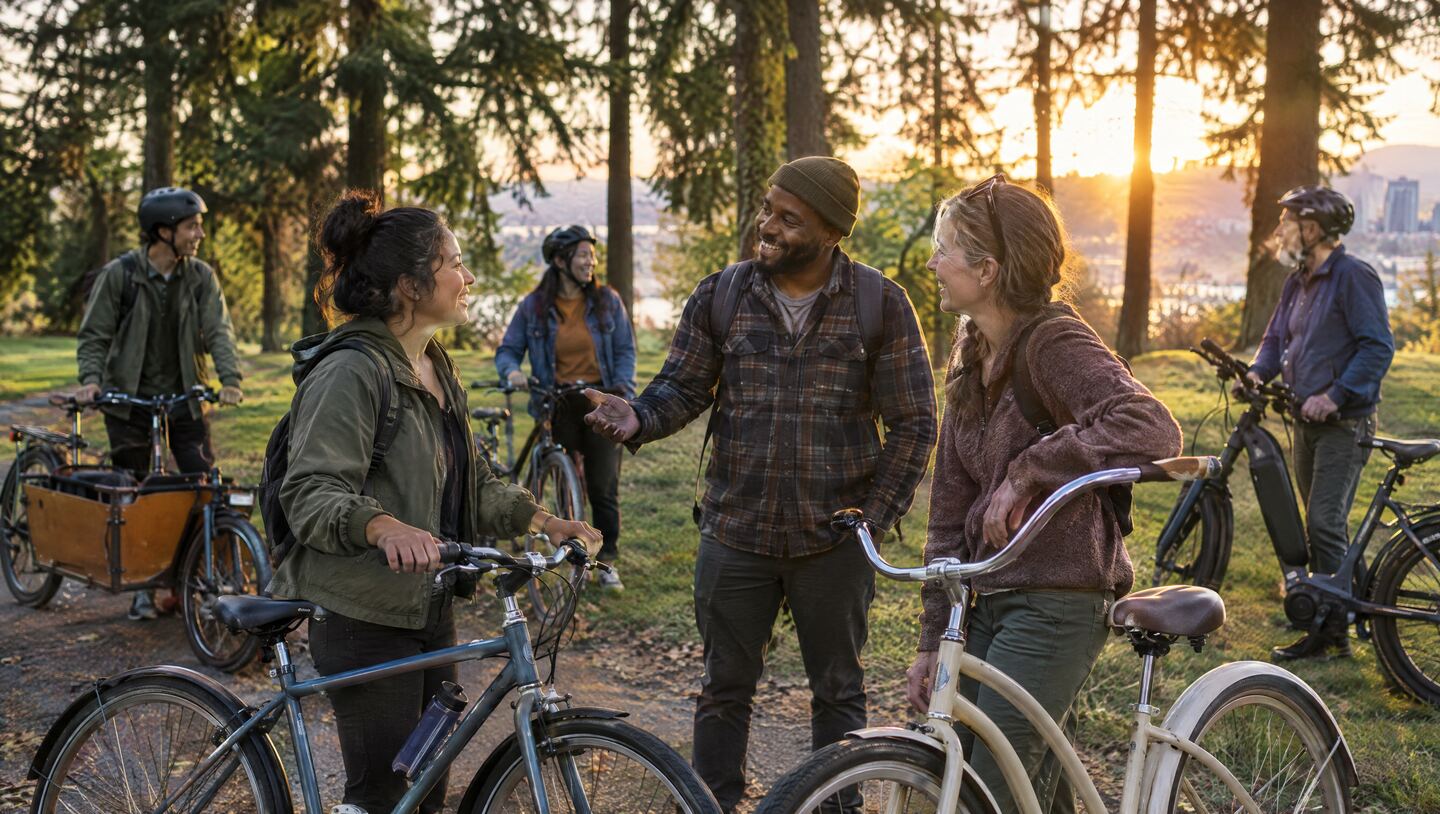
You’ll see all kinds of people on all kinds of bikes, from old commuter bikes and cruisers to road bikes, cargo bikes, and e-bikes.
There’s no dress code, and nobody needs to look a certain way to belong.
Just be kind, give people their space, and respect others and their belongings. That means asking before you touch someone’s bike or their stuff, and definitely before you touch them. Shift also has a community code of conduct that’s worth reading before you head out.
But what if I’m too slow?
This might be the most common worry people have about joining their first group ride.
And it’s a reasonable question!
The good news is that plenty of rides are designed around having fun rather than going fast.
The trick is knowing what to look for.
Party pace
You’ll see this phrase a lot in Portland ride listings.
Party pace generally means a relaxed, social speed where people can chat, enjoy the scenery, and ride without feeling like they’re in a race.
Some rides describe party pace as roughly 10 to 12 mph. Others, especially beginner-focused rides, might go closer to 6 to 9 mph.
There’s no official definition, so pay attention to how the ride leader describes it.
If you’re new to group riding, something advertised as casual, mellow, or beginner-friendly is usually a good place to start.
No-drop rides
This is another term worth knowing.
A no-drop ride is one where the group makes an effort to keep everyone together. If someone is riding more slowly or has a mechanical problem, the group will generally wait or regroup.
For a first ride, this can be especially reassuring.
A drop ride, on the other hand, doesn’t necessarily wait for people who fall behind. These are often more appropriate for experienced riders who are comfortable navigating on their own.
Some rides fall somewhere in the middle. Portland’s Thursday Night Ride, for example, has described itself as “low drop, not no drop.”
If staying with the group is important to you, look for a ride explicitly described as no-drop. And if the listing doesn’t say, ask.
Keep in mind that no-drop describes how the leader intends to run the ride, not an absolute guarantee. It’s still smart to know where you’re going and have a way to get home.
What are corkers?
On larger rides, you might notice people stopping at intersections to help the group travel through together.
These volunteers are called corkers.
Their job is to help manage the flow of a large ride and keep everyone moving together. Usually that means holding cross traffic at an intersection so the rest of the ride can keep moving. You’ll often see them rejoin the group after everyone has passed.
In practice, that can mean the group keeps rolling through after the light has turned red. Worth knowing, though: Oregon law doesn’t actually define corking, and corkers don’t have any legal authority to direct traffic. Only police do. As far as the law is concerned, the light still applies to every rider.
You don’t need to worry about doing this on your first ride, and you shouldn’t try. Corking requires experience, good judgment, and an understanding of the risks and traffic rules involved.
For now, just follow the ride leader’s guidance, watch for traffic yourself, and remember that corkers don’t override traffic laws.
And if you pass a corker helping the group, a friendly “thank you!” is always appreciated.
What if I get tired or need to leave?
Then you get tired or need to leave. It happens!
If you’re struggling to keep up, let the ride leader know sooner rather than later. They may be able to adjust the pace, help you find a shorter route, or suggest a good place to take a break.
You can also decide to leave a ride early. There’s no obligation to finish.
If you think you might, it helps to look at the route before the ride. Some rides share their planned stops in the listing, and Biiikes sometimes shows them on the ride’s page. A stop can be an easy place to peel off.
Just make sure you know how to get home, and if possible, let someone know you’re heading out so nobody goes looking for you.
Remember, this is supposed to be fun.
What about riding at night?
A lot of Portland’s group rides happen in the evening, and riding through the city after dark can be a really wonderful experience.
There’s something special about a long line of bikes, colorful lights, music, and the city passing by.
But visibility becomes especially important once the sun goes down.
Oregon law requires appropriate lighting from sunset to sunrise and during other conditions when visibility is limited.
You’ll need a white front light visible from at least 500 feet and a red rear light or reflector visible from at least 600 feet.
Even if your ride starts in daylight, bring lights if there’s any chance you’ll be out after sunset.
And don’t forget to charge them!
It’s also worth bringing an extra layer. That warm summer afternoon can feel surprisingly cool after a couple of hours riding through the city.
How do I get home afterward?
This is one of those little details that’s easy to overlook when you’re excited about a ride.
Not every group ride ends where it started.
Some follow a big loop and return to the meeting spot. Others finish at a park, a bar, someone’s favorite food cart pod, or somewhere completely different.
Before heading out, check the listing to see where the ride is expected to end.
If it isn’t clear, ask.
It’s also helpful to have a backup plan in case you get tired, decide to leave early, or the ride runs later than expected.
Taking your bike on TriMet
One of the nice things about riding in Portland is that public transit can help you get around.
Regular bicycles are allowed on TriMet buses, MAX trains, and Portland Streetcar when bike spaces are available.
There are some restrictions, especially for oversized bikes, heavier e-bikes, and cargo bikes, so check TriMet’s bike information before counting on it.
Bike spaces can fill up during busy periods or major events. And if you’re riding late at night, double-check the schedule so you don’t miss your last connection.
You can pay your fare using Hop, including a contactless credit card or your phone.
Biiikes also shows nearby transit stops on ride pages, which can be helpful when figuring out how to reach a meeting spot.
Don’t have your own bike? Try BIKETOWN!
You don’t necessarily need to own a bike to join a group ride.
Portland’s BIKETOWN bike-share program offers electric-assist bikes you can rent using its app.
The bikes come with a built-in headlight, and you can pick one up at stations throughout the service area. Riders must be at least 16 years old.
When you’re finished, you can return your bike to a BIKETOWN station or lock it to an eligible public bike rack within the service area, although additional fees may apply.
BIKETOWN also offers BIKETOWN for All, a discounted membership program for qualifying riders, including people enrolled in programs like SNAP or the Oregon Health Plan.
One important thing to know: BIKETOWN bikes cannot be brought onto buses or trains. And since you’re paying to rent the bike, be mindful of how long the ride might last.
Biiikes makes planning a little easier by showing available BIKETOWN bikes near a ride’s meeting location, starting the day before the ride and continuing until its departure.
One last thing before you head out
Ride plans sometimes change.
Weather happens. Routes get adjusted. Meeting spots move. Occasionally, rides get canceled.
It’s always a good idea to check the ride’s page one more time before leaving home, especially if the weather looks questionable.
If you’ve marked yourself as going on Biiikes, you’ll also have an easier way to keep track of your upcoming rides.
See you out there!
If there’s one thing we hope you take away from this guide, it’s that you don’t need to be an experienced cyclist, know a bunch of people, or have the perfect bike to enjoy a group ride.
You just need to find something that sounds fun and give it a try.
Maybe you’ll make a new friend. Maybe you’ll discover a part of Portland you’ve never seen before. Maybe you’ll end up dancing in a park surrounded by a hundred people on bikes.
Or maybe you’ll just have a nice evening riding around town.
All of those are pretty great outcomes.
And remember, every experienced group rider was a first-timer once, too.
Pick a ride. Show up. Say hello. Have fun.
We’ll see you out there!